What are you really investing in when you landscape your property — and do you have the right professional to get you there?
Two Types of Returns, One Decision: What Kind of Outdoor Investment Are You Making?
Every homeowner who puts money into their outdoor space is making a decision — whether they realize it or not. The question isn't simply, "What do I want my yard to look like?" It runs deeper than that: What am I actually investing for?
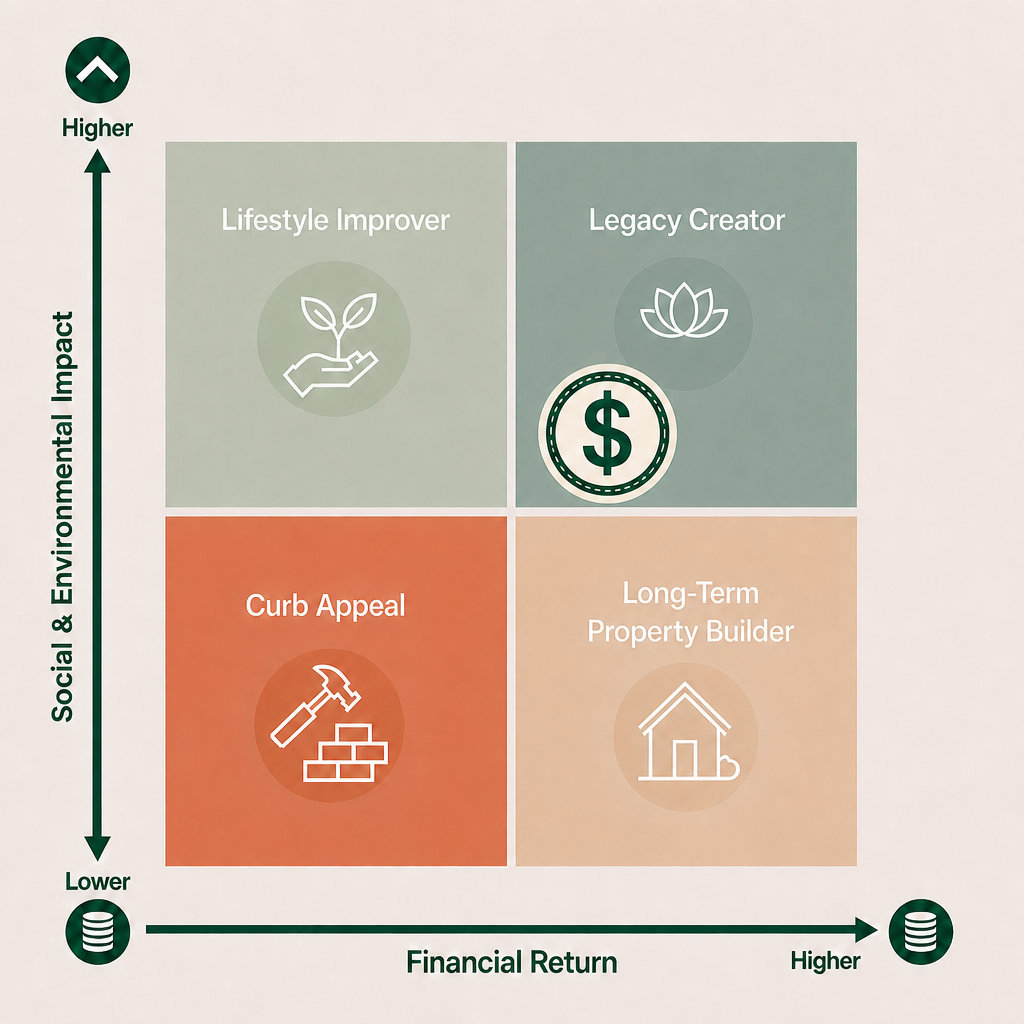
Two dimensions define every outdoor investment. First, what kind of return are you after — financial return, or quality-of-life return (or both)? Second, how significant is the investment? Where you fall on those two axes shapes everything: what you build, what you prioritize, and critically, who you bring in to help you get there.
ROI and ROL: The Two Types of Return
ROI — Return on Investment is landscaping as a financial instrument. The numbers make a compelling case. According to National Association of Realtors (NAR) data, professional landscaping can add 15–20% to a home's value. Lawn care alone returns up to 217% of its cost at resale. Landscape upgrades recover, on average, 100% of their investment when a home is sold. Few home improvements come close to that performance.
But there's another return worth measuring: ROL — Return on Life.
ROL is what your outdoor space gives you every single day you live in it. It's the morning coffee on a well-designed terrace. The evening gathering that actually works because the space was built for it. The quiet sense of calm that comes from stepping outside into something that feels exactly right. Research consistently links regular access to well-designed outdoor environments with reduced stress, improved mental health, and higher daily productivity. These are not soft benefits — they are real, measurable outcomes that compound over time. An outdoor space that genuinely supports how you live is an investment in your wellbeing, not just your property.
The same NAR research that tracks financial return also tracks "Joy Scores" — how much daily happiness a completed project delivers. Outdoor improvements score between 9.6 and 10 out of 10. That's not a coincidence. A well-designed landscape pays you back every day, not just when you sell.
The best projects deliver both ROI and ROL. But knowing which return matters most to you shapes every decision before a single plan is drawn.
The Four Outdoor Investor Types
The Curb Appeal Seller — ROI / Lower Investment
Selling soon and want the property to shine. The goal is fast, visible impact — but that doesn't mean stripping out what's already there and replacing it with small, inexpensive trees and shrubs that haven't had time to establish. More often than not, the smartest move is to assess what's already working and build around it. Mature plantings that have grown into the property carry a presence and credibility that no nursery truck can deliver overnight. The right approach identifies those assets, refines what surrounds them, and makes targeted additions that complete the picture.
The Long-Term Property Builder — ROI / High Investment
Playing the long game. Whether holding for capital growth or simply building an asset that matures well over time, the priority is a landscape that is robust, timeless, and adds measurable value year after year. Strategic thinking about site organization, hardscaping, and planting systems matters here — not just surface aesthetics. A phased master plan is particularly well-suited to this type of investor: the full vision is established upfront, and construction is sequenced over time in a way that is budget-conscious without ever losing coherence.
The Lifestyle Improver — ROL / Lower Investment
Not selling. Just ready to enjoy the space more. Perhaps it's a better patio, a more usable backyard, or finally addressing the drainage issue that's been quietly causing problems for years. Comfort and everyday functionality take priority over resale metrics.
The Legacy Creator — ROL / High Investment
This client isn't building a landscape — they're building a life outside. They want an outdoor environment that reflects who they are: how they live, how they entertain, and what they value. The investment is significant because the intention is significant. These are spaces meant to feel deeply personal, to mature gracefully, and to be enjoyed for decades without the desire to change them.
Many homeowners find themselves between two of these types — a Legacy Creator who also cares about long-term property value, for instance, is more common than not. The goal isn't to fit neatly into one category. It's to get honest about your priorities before any design decision is made.
Why Your Goals Determine Who You Hire
The scale and permanence of your investment determines the level of professional expertise it deserves. In the landscape world, not all professionals are the same.
A landscaper installs and maintains. They are the builder — skilled at execution — but they are not the author of the plan.
A landscape designer creates residential plans with a focus on aesthetics, spatial composition, and planting. This is design work in the truest sense — it requires a trained eye, an understanding of how people move through and experience space, and genuine horticultural knowledge.
A Registered Landscape Architect adds another layer: state licensure. They have completed an accredited degree, passed the Landscape Architect Registration Examination (LARE), and hold a license that carries legal accountability for the work. They can stamp drawings for permit submission and are trained to manage grading, drainage, retaining structures, zoning compliance, and coordination across the full project team — architects, engineers, and builders included.
There is a common misconception that landscape architects only work on large commercial projects — parks, campuses, civic infrastructure. Many specialize in high-end residential work, and the technical depth they bring is precisely what complex, high-investment sites require.
At Schieber & Associates, we employ both. Our registered landscape architect brings the licensed technical oversight that protects your investment and ensures every site decision holds up — structurally, legally, and long-term. Our landscape designers bring the aesthetic depth and spatial thinking that makes a plan feel considered and personal. The two work in concert, which means you don't have to choose between artistry and accountability.
The Process That Protects Your Investment
Regardless of whether you are investing for ROI or ROL, the quality of the outcome depends on the quality of the process.
A firm with registered landscape architects on staff follows a time-honored design process built to help you get the best return on every dollar you spend. That process is not simply about producing beautiful drawings. It is about making the right decisions in the right order — site analysis, program development, grading and drainage strategy, planting systems matched to the actual microclimate and soil conditions of your property — all resolved before anything is built.
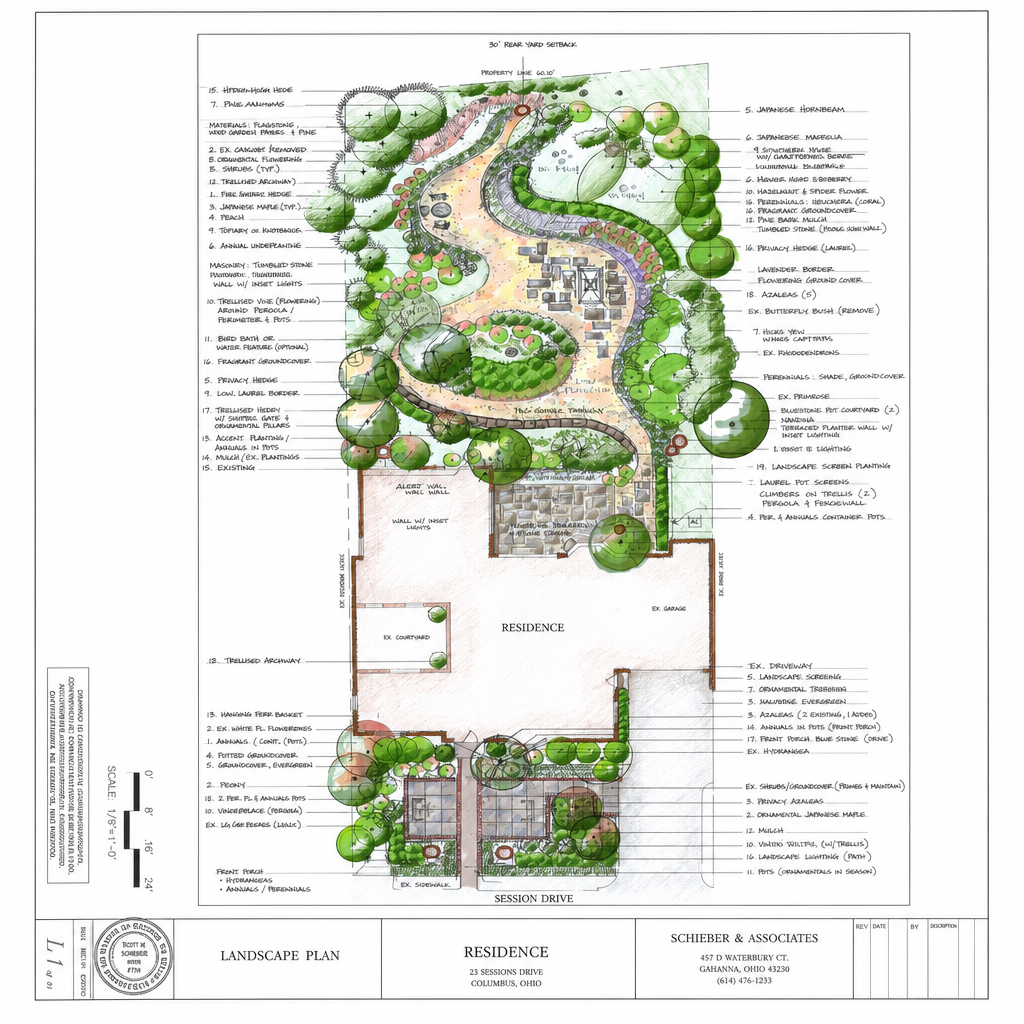
Central to that process is the master plan. A well-developed master plan captures the full vision for your property and establishes a clear, coherent framework for every decision that follows. One of its most practical advantages is that it makes phasing possible. Rather than committing to the entire scope at once, you can execute the plan in deliberate stages — prioritizing what matters most now, while knowing that every future phase fits naturally into the larger picture. Nothing gets built that contradicts what comes next. Nothing has to be torn out and redone because the plan changed. The integrity of the whole is protected from the very beginning.
This is what separates a landscape that performs and delights for decades from one that grows piecemeal and eventually needs to be rethought from the ground up. The most consequential work happens before the first shovel enters the ground. Early involvement protects your budget, prevents costly mistakes, and ensures the site works at every level — for the life you intend to live in it.
Know Your Return Before You Begin
Whether you are building for legacy, for long-term property value, or for both — clarity about what you are investing toward matters before the first decision is made.
The right firm does not simply execute a plan. They help you define what you are truly building, develop the strategy to get there, and guide the process in a way that is clear, collaborative, and genuinely enjoyable — from the first conversation to the finished site.
At Schieber & Associates, that is exactly how we work.
Sources
- National Association of Realtors (NAR) Remodeling Impact Report — ROI and Joy Score data for outdoor improvements
- American Society of Landscape Architects (ASLA) — residential landscape investment guidelines
- Virginia Tech / Opendoor research — resale value data for professional landscaping
- LawnStarter — Joy Score analysis for outdoor home improvements
- Land8 — professional distinctions in landscape practice
- Verdance Design — landscape architect vs. landscape designer legal distinctions
- OES Design — differentiating roles of landscape professionals
- Dabney Collins — landscape designer vs. architect explained