The Cheapest Architect Rarely Delivers the Cheapest Project
The Cheapest Landscape Architect Rarely Delivers the Cheapest Project
Challenge
When a high-end residential project is taking shape, landscape architecture fees can feel like a natural place to economize. The house is the centerpiece. The structure is where the major investment lives. So when someone suggests trimming costs by delaying the landscape architect, hiring the least expensive option, or simply asking a design-build garden center to handle the exterior once the building is done, it can seem like a reasonable trade-off.
It rarely is.
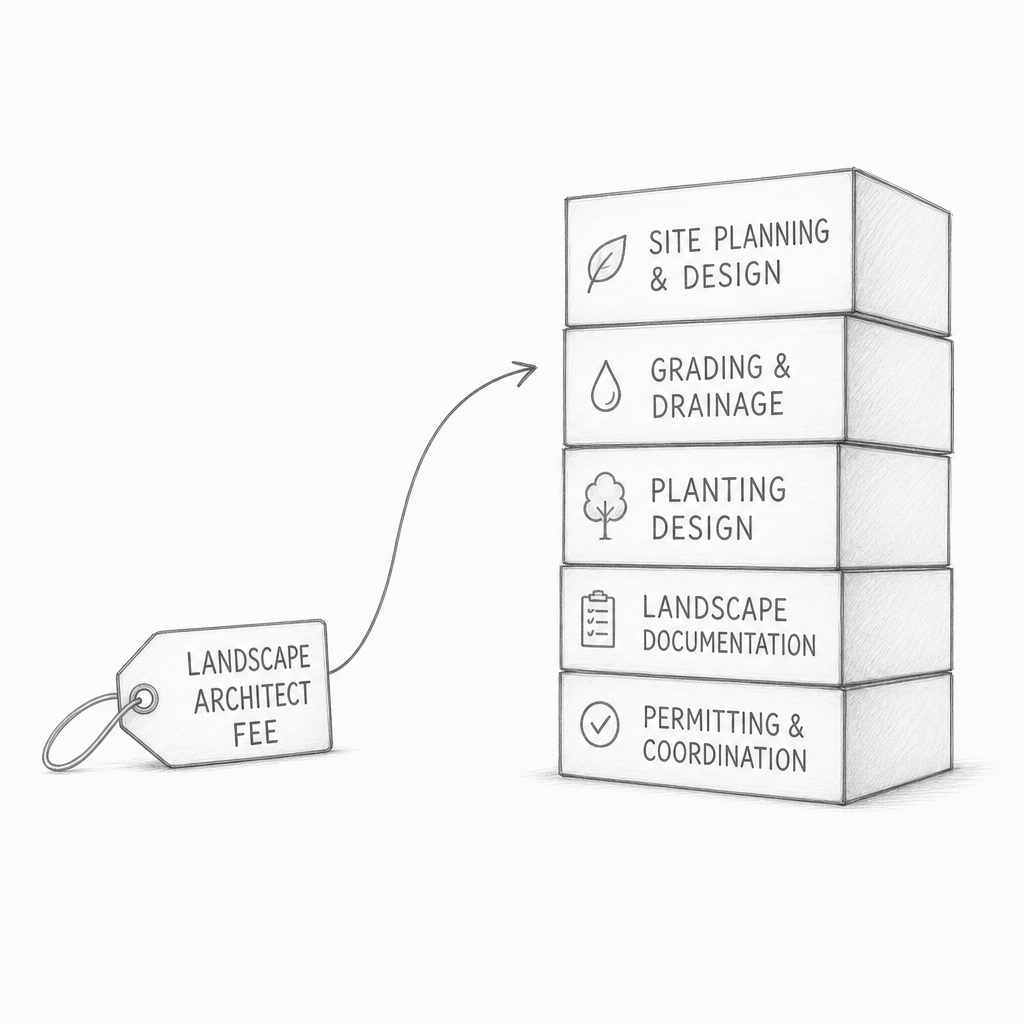
The exterior environment is not a finishing touch applied after the building is set. It is a complex, interconnected system — grading, drainage, circulation, transitional spaces, planting, safety, and long-term site performance — that must be organized in relationship to the structure from the very beginning. When it isn't, the cost of correcting that sequence does not look like landscape fees. It looks like retaining walls, failed plantings, liability exposures, and significant construction rework.
Insight
The idea that a lower landscape architecture fee saves money is understandable. But it misidentifies where the real money gets spent.
On a well-planned site, the landscape architect's fee is a fraction of the total construction cost. On a poorly planned site, the construction cost itself — the retaining walls, the drainage corrections, the misaligned driveway grades, the replanted beds that didn't survive the first season — becomes the real expense. The fee was never the problem. The sequence and the quality of judgment behind it were.
There are several specific places where this plays out on a residential site.
Grading and Drainage
Water strategy is one of the most consequential decisions made on a residential property, and it must be resolved early. If building placement and finished floor elevations are locked in without a coordinated grading plan, the path water takes across the property gets locked in too — often toward the foundation, into low-lying outdoor spaces, or across drives and walks that become hazardous in winter. Correcting those conditions after construction may require recontouring significant areas, installing drainage infrastructure, or building retaining walls to create usable, level spaces that should have been designed from day one. These are not landscape features. They are expensive corrections.
Safety and Liability
Exterior steps, walks, and grade transitions that are designed without technical expertise create real liability. The riser-to-tread ratio for an exterior step is not the same as an interior stair — and getting it wrong does not just look awkward. It creates a fall hazard. State Registered Landscape Architects understand these standards, think carefully about movement and safety across a full range of users and ages, and design exterior environments accordingly. When those decisions are made by someone without that training, or not made at all, the client inherits the risk.
Microclimates and Plant Selection
A landscape that isn't planned around the hyper-local realities of a specific site — soil conditions, sun and shade patterns, wind exposure, drainage behavior — will fail. Not eventually. Often within the first growing season. The right plant in the wrong spot is simply a plant with a shorter life. Replacing it costs money. Repeating the mistake costs more. An experienced landscape architect understands that what thrives on one side of town may struggle on the other side of a river, and they design with that precision in mind.
The Timing Problem
Perhaps the most expensive version of this mistake is not the decision to hire the cheapest firm — it is the decision to hire any firm too late. When a landscape architect is called in after the building has been positioned on the lot, after driveways and walks have been poured, and after major grading decisions have been established, the options for creating a coherent, high-performing exterior environment narrow considerably. At that point, the landscape architect is no longer designing the site. They are working around decisions that have already been made — decisions that may now require retaining walls to manage grade changes, drainage corrections to fix what the building placement created, or significant creative problem-solving to compensate for a circulation plan that was never coordinated site-wide.
The property does not need a landscape architect at the end. It needs one at the beginning.
Approach
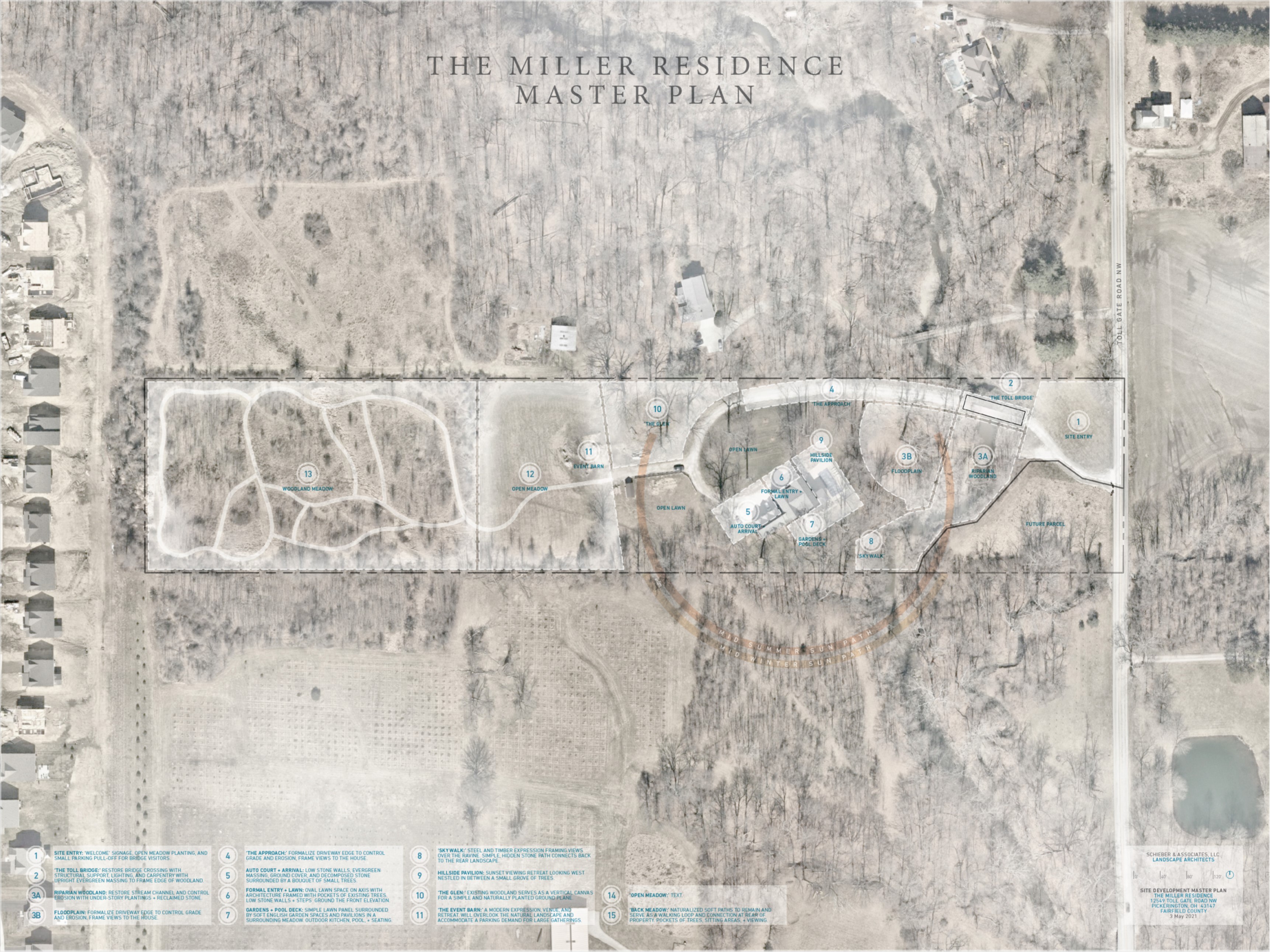
At Schieber & Associates, our strongest case for early engagement is a practical one: the decisions made in the first phase of a project — where the building sits on the lot, what elevation it meets the ground, how traffic flows across the property, where water goes when it rains — determine the cost and quality of everything that follows.
We are most useful before those decisions are made. And we work best when we are part of the full team — alongside the architect, engineer, and builder — contributing the exterior site strategy that makes the whole project cohere.
That early involvement is not simply about our process. It is about protecting everyone involved. When a landscape architect is part of the conversation from the start, the builder has a coordinated grading and drainage plan to build to. The architect has a site layout that places the building where it can be properly served by drives, walks, and outdoor rooms. The client has a clear picture of what their full exterior environment will look like, cost, and deliver — before a dollar of construction has been committed.
Mark Schieber has held a State Registered Landscape Architect license in Ohio since 1985, and that distinction carries real weight in practice. The technical decisions we make — about grade, water movement, exterior safety, and site organization — are not decorative opinions. They are engineered site solutions delivered by a credentialed professional who carries legal responsibility for that work. That distinction becomes most visible when something goes wrong, and most valuable when it prevents something from going wrong at all.
We also recognize that our clients' time is valuable and that the design process can feel complex. We work to make it straightforward. We guide the process systematically, keep communication clear, and ensure clients understand the decisions in front of them — not just the options, but why each one matters for their specific property and long-term goals. The process should be enjoyable, and with the right team organized in the right order, it genuinely is.
Result
We were called to a project in Old Worthington — an older Cape Cod home that had recently gone through an interior renovation. A builder had handled the exterior scope: a deck, a patio, a walkway, and a driveway. The intent was reasonable. The outcome was not.
By the time we were brought in, the client had spent approximately $20,000 on exterior work that had to be substantially reconsidered. The deck steps presented a genuine safety liability — the riser-to-tread ratio was incorrect for exterior use. The driveway access was misaligned for the site. The front-door approach created additional problems. They had inherited a set of conditions that were difficult to correct without dismantling what had already been built.
We could not simply start over. We had to work within the constraints of what existed, improve what could be improved, and plan a responsible path forward. The client's money had been spent — but not in a way that served their property, their safety, or their investment.
What stood out was not the technical error itself. Mistakes are correctable. What stood out was that none of it needed to happen. A competent exterior site plan, developed before the builder broke ground, would have avoided every one of those conditions. The fee for that planning would have been a fraction of the cost of the rework.
What This Means For You
If you are a homeowner planning a significant residential project — or a builder, architect, or engineer working alongside one — this is worth understanding clearly.
The landscape architect's fee is not a discretionary line item to trim at the end of the budget conversation. It is an investment in the quality and coherence of every exterior decision made on that site. Reducing it, delaying it, or replacing it with a less qualified option does not reduce the cost of the project. It relocates that cost — into construction corrections, drainage repairs, safety liabilities, and plantings that don't survive.
The right landscape architect, engaged at the right time, does not add complexity to a project. They reduce it. They bring site-wide clarity to a set of decisions that would otherwise get made piecemeal — sometimes by people who were never trained to make them.
For builders and architects, a well-qualified landscape architect also functions as a professional safeguard for the entire team. When exterior conditions are designed correctly from the start — grades, drainage, safety transitions, circulation — everyone involved is better protected. When they are not, everyone who touched the project carries some degree of exposure.
The most expensive landscape plan is almost never the one with the highest fee. It is the one that was hired last, or not at all.
If your project involves significant grade change, water management challenges, complex site programming, or simply a property that needs to perform well and look its best for decades to come, we welcome a conversation early — ideally before the builder has started or the architect has locked in building placement.
That is where we add the most value. And as it turns out, that is also where we can save you the most money.