How to Hire an Architect for Your Home (Without Regretting It Later)
How to Hire a Landscape Architect for Your Property (Without Regretting It Later)
Most people give careful thought to hiring the right builder or building architect. They review portfolios, check references, and ask thoughtful questions about timelines and fees. But when it comes to the outdoor environment — the land that surrounds, supports, and contextualizes everything that will be built — the hiring decision is often rushed, delayed, or handed off to the wrong professional entirely.
That oversight tends to be expensive.
At Schieber & Associates, we are State Registered Landscape Architects specializing in high-end residential site development and master planning across Central Ohio and the broader Midwest. We have spent decades helping clients untangle the consequences of bringing the right expertise in too late — and we have seen firsthand what it costs when they do. This is our straightforward guide to making a better decision from the start.
Start Earlier Than You Think — Much Earlier
The single most consequential decision in hiring a landscape architect is when you make the call.
The conventional approach — design the house, build it, then figure out the landscaping — consistently produces the most expensive outcomes. Building placement, finished floor elevations, driveway grades, utility locations, and drainage patterns are all deeply interconnected with exterior site design. When those structural decisions get locked in before a landscape architect has reviewed the property, the outdoor environment is forced to accommodate whatever remains — and what remains is rarely optimal.
We believe the landscape architect should be one of the first professionals engaged in any significant property project. Ideally, that means a call during property selection or immediately upon purchase — before the building architect has committed to placement and before the builder has broken ground. At the property-wide scale, the landscape architect is the one who organizes the site: where structures sit, how they relate to grade changes, how water flows, how people move, and how all of it comes together as a coherent, functional environment.
Consider how Daniel Burnham and Frederick Law Olmsted divided responsibilities at the 1893 World's Columbian Exposition in Chicago. Burnham controlled the buildings; Olmsted commanded the exterior — the walkways, water features, plantings, and the full experience of moving through the grounds. Those weren't afterthoughts. They were the organizing framework around which everything else was understood and appreciated. The same principle applies to your property.
Early engagement prevents the mistakes that cost the most. When a structure is positioned without understanding the site's grading, drainage patterns, or topographic constraints, the corrective measures — retaining walls, recontouring (reshaping the land to redirect water), forced drainage infrastructure — can run into the hundreds of thousands of dollars. Preventing those costs is straightforward. Correcting them after the fact is not.
Look for the Right Credentials and the Right Kind of Experience
Not everyone who designs landscapes is legally or technically qualified to do so at a professional level. This distinction matters — and it carries real implications for the safety and longevity of your project.
In Ohio, the title "Landscape Architect" is a protected designation. To use it, a professional must hold a state-issued license requiring passage of rigorous examinations and fulfillment of specific educational and experience standards. Someone without that licensure is a "Landscape Designer" — and while designers may bring meaningful skills to a project, they do not carry the same legal, technical, or professional accountability as a State Registered Landscape Architect.
This is not simply a credentialing formality. Exterior environments involve genuine safety considerations: proper riser–tread ratios for exterior steps (the precise relationship between step height and depth that determines whether a stairway can be navigated safely in all conditions), accessible and code-compliant circulation routes, grading and drainage that prevent hazardous standing water or erosion, and structural requirements for transitional spaces such as decks, arbors, and terraces. Getting these wrong creates liability — and, in our experience, it also creates significant remediation costs that fall squarely on the property owner.
Beyond licensure, look for demonstrated experience with the types of site challenges your property presents. Difficult topography, significant grade changes, water management issues, strict zoning constraints, and the need to preserve valuable existing vegetation are all areas where professional depth makes a measurable difference. We built our practice around exactly these kinds of sites. Terrain with complex grade changes and challenging drainage isn't a problem to us — it is where our best work happens and, frankly, where we have the most fun.
We also encourage clients to resist the temptation of filling the landscape role with a garden center, nursery, or general contractor. Those professionals serve important functions, but they are not equipped to provide the property-wide strategic planning, site engineering coordination, or the professional accountability that comes with registered practice.
Expect — and Insist On — a Structured Process
A qualified landscape architect should be able to describe their process clearly before any drawings are produced. If the answer is vague, that is a signal worth heeding.
Our process begins with what we call an LCC — a Low-Commitment-Consultation. This front-end diagnostic session allows us to examine the site, understand the client's program and priorities, identify constraints, and develop an initial framework for how the property can be organized most effectively. It is the foundation for everything that follows, and it ensures that major decisions are not made based on assumptions or incomplete information.
From there, the process should be systematic, collaborative, and — perhaps surprisingly to those who have not worked with a professional landscape architect before — genuinely enjoyable. Designing your outdoor environment should not feel overwhelming. A professional team should guide you through the decision-making in a logical sequence, explaining trade-offs in plain language and making room for your preferences and priorities to shape the outcome. Our goal, in every engagement, is for the process to feel guided and diplomatic, with room for creativity within a disciplined framework.
Equally important is the question of how your landscape architect works with the rest of your project team. Site development cannot exist in isolation from architecture, engineering, and construction. We work actively alongside your building architect, structural engineer, and general contractor — not as a downstream consultant brought in after the foundational decisions are already made, but as an integrated member of the design team from early in the project. That coordination is where costly errors are prevented and where the project begins to perform as a coherent whole rather than a collection of disconnected decisions.
The following story illustrates what happens when this coordination is absent. We were engaged to assist a family in Worthington — a well-established Columbus neighborhood — after a builder had already completed an interior renovation and constructed the primary exterior elements: the deck, patio, front walk, and driveway. The clients came to us looking for landscaping and drainage solutions. What we encountered was considerably more complex. The deck steps presented a clear safety liability. The front entry had an incorrect riser–tread ratio, exposing the homeowners to real risk of injury. The driveway access was poorly positioned for safe and efficient use. Correcting what had already been built — while working within the constraint that the clients could not demolish everything and start over — required careful, disciplined problem-solving. By the time we were engaged, the family had already spent approximately $20,000 on work that had created more problems than it resolved. That expenditure was effectively erroneous — money spent on decisions that the right expertise, applied at the right moment, would have prevented.
That story is not unusual. It reflects what happens when the landscape architect is treated as an afterthought. The cost, the frustration, and the liability exposure were entirely preventable.
Clear Communication Is a Professional Responsibility
The right landscape architect should be able to explain complex site challenges in plain language — without condescension, and without oversimplification. You should understand the trade-offs, the reasoning, and the implications of every major decision before you approve it.
In practice, that means your questions should receive direct, informative answers. You should know what is technically constrained versus what is discretionary, and you should understand the long-term consequences of each major choice. If a planting selection is limited by soil conditions or microclimate (the hyper-local variations in temperature, moisture, and sun exposure that determine what will actually thrive in a given location on your property), you deserve to understand why — and what that means for the health and longevity of the landscape over time.
We commit to that standard in every client engagement. Our goal is for you to feel guided, not managed — and confident in the decisions you are making, rather than pressured into them.
Understand What You Are Actually Investing In
Comprehensive site development is a meaningful investment, and clients who approach it with realistic expectations consistently achieve better outcomes than those who treat the exterior environment as an afterthought on the budget sheet.
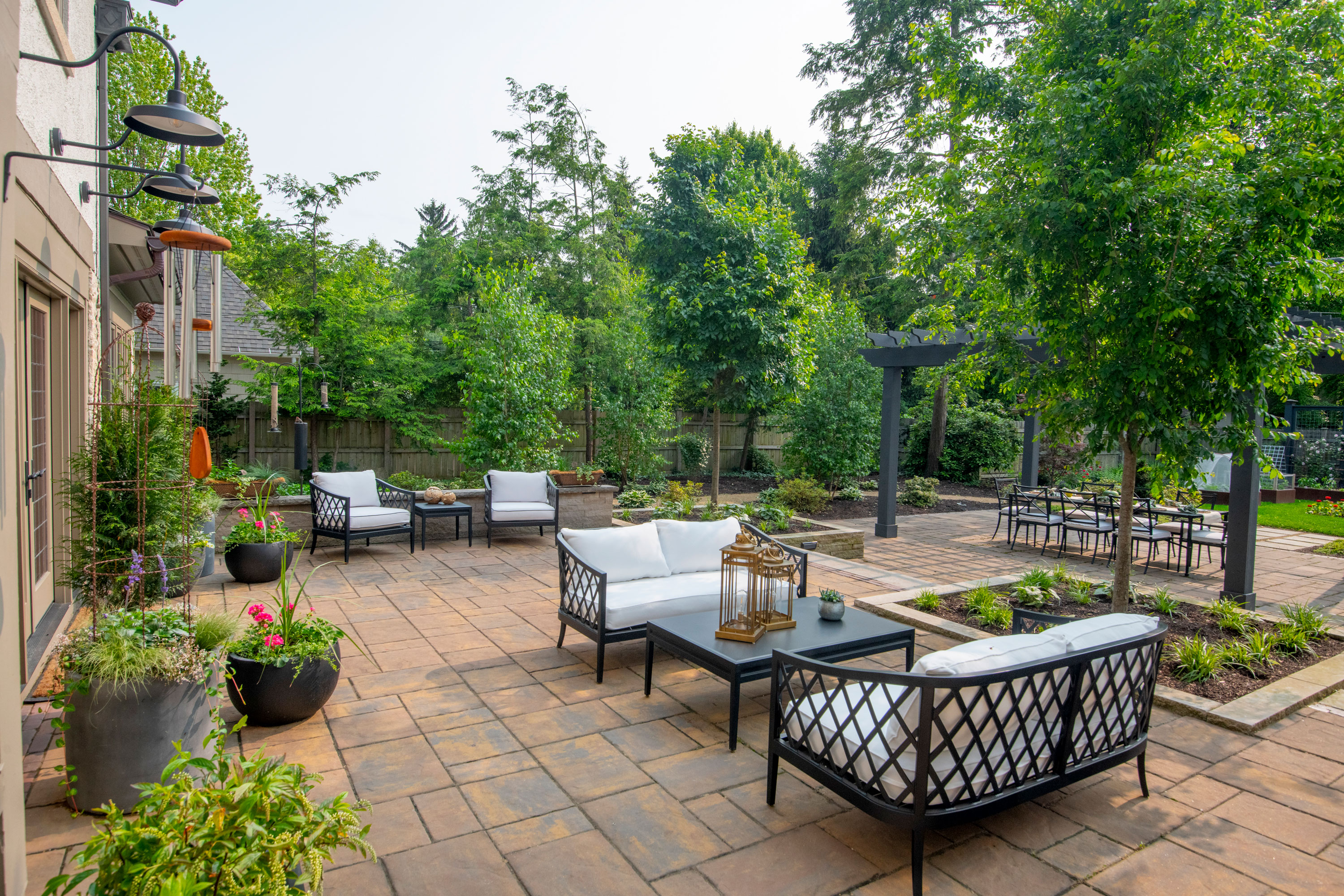
At Schieber & Associates, our primary focus is high-end residential properties with exterior construction budgets of $500,000 and above, with total site development scopes that can extend well beyond that on complex properties. That figure does not include the house. It reflects the true cost of executing the exterior environment correctly: grading and drainage systems, site structures (pools, outbuildings, pool houses, outdoor kitchens, arbors, decks, transitional spaces like sunrooms, decks, and porches), circulation infrastructure (drives, walks, and entry elements), planting systems, lighting, and irrigation — all designed as an integrated exterior system, not assembled piecemeal over time.
Professional design fees are proportional to that investment. A useful rule of thumb: on a $1,000,000 exterior construction project, professional fees in the range of 10% represent $100,000. Applied by the right team at the right moment in the project, that investment is among the highest-returning expenditures on the property — not because it buys drawings, but because it prevents the expensive mistakes that occur when decisions are made without proper professional guidance.
The framing that matters most to us is stewardship. We view your property as both a personal refuge and a long-term financial asset. Thoughtful, early site planning protects that asset by preventing rework, reducing liability, ensuring that landscapes mature gracefully over decades rather than requiring replacement within a few years, and — perhaps most importantly — making the property more meaningful, more functional, and more marketable over its lifetime.
What This Means For You
If you are planning a significant property project — whether you are in the process of selecting land, beginning a custom build, or reconsidering an established estate — the most important question you can ask is: Have I brought in the right exterior expertise, and have I brought them in early enough?
If the answer is no, or not yet, now is the time to change that.
We would welcome the opportunity to begin with an LCC — a focused, diagnostic conversation about your site, your program, and where the greatest opportunities and risks reside. The process is systematic, diplomatic, and genuinely enjoyable. And the decisions you make at the beginning of a project are the ones that shape everything that follows.
Schieber & Associates — Architects of the Outdoors.