How to Compare Outdoor Construction Materials Beyond Upfront Price
The Real Cost of "Affordable": Why the Cheapest Material Rarely Stays That Way
A contractor colleague reached out recently while we were talking through our newsletter series and its upcoming topics. He raised something that has been on his mind for a while. He is good at his job, he cares about the work — and no matter how clearly he explains it, he cannot always talk his clients out of stamped concrete. Not because they don't understand the concern. Because someone always, eventually, reaches for the rock salt. As he put it: "Someone always ends up forgetting it can't take salt."
He's not wrong. And his candor is what prompted this article.
A lot of outdoor material decisions get made based on what looks best on a quote — not what performs best over ten or twenty years. The gap between that upfront number and the true cost of ownership is where expensive surprises tend to live. So before you sign off on a material, here's how we'd suggest thinking about it.
One practical note before we dive in: scale affects every number in this article. Larger installations spread contractor mobilization, equipment, and material delivery costs across more square footage — bringing per-square-foot costs down. Smaller projects carry those same fixed costs across less area, which is why per-square-foot pricing on smaller installations tends to run higher.
Three Questions Worth Asking Before You Commit
Before comparing any two materials side by side, ask:
- What will this cost to maintain over 10–20 years — in time, labor, and money?
- What happens when it needs repair — can you replace a section, or does the whole surface need to come out?
- How does it hold up in an Ohio winter — freeze-thaw cycles, deicing salt, snowplows, and all?
The answers tend to reframe the quote pretty quickly.
Paving: Four Options, Four Very Different Stories
Finished concrete (~$12–$22/sq ft installed for a quality finish; $22–$30+ for elaborate stamped or multi-color work) usually carries the lowest upfront cost — and in a Midwest climate, often the highest long-term risk. It needs resealing every two to four years to protect its surface and color. More critically, it does not get along with deicing salt. Freeze-thaw exposure and salt combine to cause scaling, spalling, and cracking — and those cracks are almost never invisible when repaired. Here's the honest position we hold on any concrete surface: it's not a question of if it will crack, but when. Know that going in.
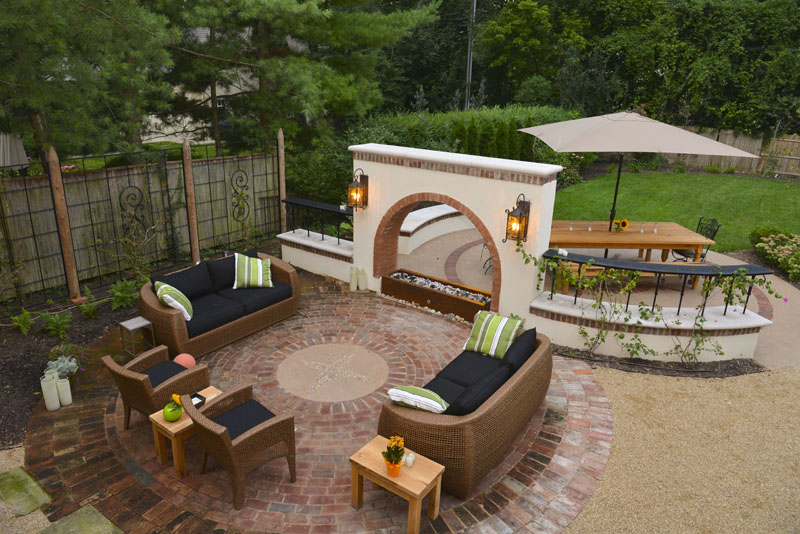
Concrete pavers (~$16–$24/sq ft installed for a standard high-quality patio; $24–$36+ for premium products, complex patterns, or challenging sites) cost more upfront but offer something finished concrete simply cannot — individual unit replaceability. One cracked paver gets swapped, not resurfaced. They're significantly more resistant to freeze-thaw and deicing salt, with a 25–50 year lifespan when the base and drainage are properly executed. For most Ohio homeowners, they represent the best balance of cost, durability, and repair practicality. One word of caution: manufactured pavers can fade and date quickly. We've seen trendy styles look tired within five years — and when it comes time to sell, a dated paver surface can actively work against your resale value. Finding a matching replacement also becomes nearly impossible once a product line changes. If you go this route, always order extra material and store it. Future-you will be very glad you did.
For a deeper look at how landscape and hardscape decisions affect your property's long-term marketability, see our article: _How a Professional Landscape Master Plan Supercharges Resale Value and Marketability._
Natural stone (dry-laid: ~$22–$48+/sq ft; wet-set: ~$30–$65+/sq ft, depending on stone type, complexity, and site) offers the longest potential lifespan — 50–100+ years for the right material, properly installed. Dense granite ($30–$45/sq ft dry-laid and up) and certain bluestone ($28–$42/sq ft and up) handle freeze-thaw conditions well. Porous limestone and sandstone are a different story; they absorb water, and water that freezes inside stone does real damage. Specify stone by absorption and performance data, not by appearance alone.
Porcelain pavers (~$20–$40/sq ft dry-laid; $35–$60+/sq ft when a concrete slab base is required) have emerged as a compelling premium option. Their ultra-low water absorption (≤0.5%) makes them naturally resistant to freeze-thaw damage, and they require very little routine maintenance — no sealing, just cleaning. They're particularly well-suited to pool surrounds, outdoor kitchens, and high-visibility contemporary spaces. Many contractors will only install porcelain over a concrete slab base — which adds meaningfully to the overall cost. The critical caveat in either case: the installation system has to be right. Porcelain is unforgiving of a poor base, and bonded systems are significantly harder to repair than modular options. The surface can perform beautifully; the substrate has to earn it.
A Note on Installation Method: Dry-Laid vs. Wet-Set
Both are legitimate approaches — the right choice depends on the application, drainage design, and project goals.
Dry-laid pavers and stone are set over a compacted aggregate base, allowing individual units to be lifted and reset as needed. The trade-off: all dry-laid installations require periodic joint material replacement, and open joints can attract weeds over time — an ongoing maintenance consideration that's easy to underestimate.
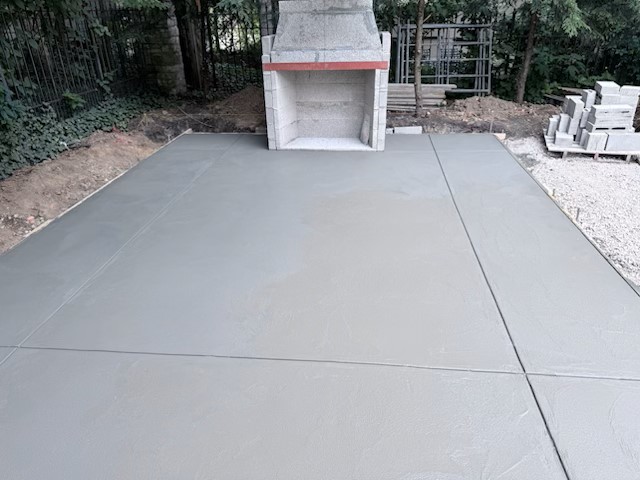
Wet-set installations use mortar and grout over a concrete slab — not polymeric sand joints, which doesn't last as long and needs periodic replacement. Wet-set assemblies are more rigid, more level, and typically $8–$15/sq ft more expensive than their dry-laid equivalent. The maintenance picture is quite different though: mortar joints hold up significantly longer than dry-laid joint material and only need occasional spot repointing rather than wholesale replacement. They also don't attract weeds. Crucially, a well-drained wet-set base effectively takes the freeze-thaw concern off the table — it's drainage that protects the assembly, not the installation method itself. A properly engineered slab with effective drainage is a durable, long-performing system. Wet-set is best suited for applications where a rigid, stable surface is essential, or where a sound existing slab makes it the practical choice.
On warranties: One advantage manufactured paving materials hold over natural stone — and one that extends to composite decking, vinyl, and aluminum fencing as well — is the product warranty. Manufactured products often come with warranties that natural materials simply can't offer, and that's worth factoring into your decision. Just read the fine print: warranties typically cover the product itself, not the cost of labor to remove and reinstall it, or delivery charges. When a warrantied paver, board, or fence section fails, the replacement material may be free — but getting it installed usually isn't.
Decking: Four Options, Very Different Outcomes
Pressure-treated wood ($20–$35/sq ft installed) gets projects started at a lower number — and that number is real, for about the first three years. Then the maintenance cycle begins. For a 300 sq ft deck, professional staining and sealing runs approximately $450–$1,200 per visit. At a three-year interval over twenty years, that's $3,000–$8,000 or more before any board replacement — on a surface with a typical lifespan of 10–20 years. It's also worth noting that the quality of pressure-treated lumber has declined in recent years, with higher rates of warping and checking becoming increasingly common — a factor worth weighing when evaluating long-term appearance and performance.
Composite ($28–$45+/sq ft) requires no staining, no sealing — just soap and water. Its 25–50 year lifespan and dramatically reduced maintenance burden narrow the cost gap considerably when you run the numbers over time. Composite decking also comes in a range of quality grades and board styles, allowing you to match your level of investment to your performance expectations — higher-grade products offer better fade resistance, harder surfaces, and longer warranties.
Ipe and other hardwoods ($35–$60+/sq ft installed) take the longest view: 40–75 year lifespans, natural density that resists freeze-thaw movement, and — if you allow the wood to silver naturally — essentially no oiling cycle to maintain. For the right project and the right client, hardwood often delivers the lowest annualized cost over a long ownership period.
Stone or porcelain on a pedestal or grid system (~$45–$100+/sq ft installed, depending on substrate, waterproofing requirements, and paver material selected) is in a category of its own. Individual pavers — porcelain or natural stone — are supported on adjustable pedestals with open joints that allow water to drain beneath the surface, creating a premium masonry-like finish with no rot, no splinters, and no staining cycle. Individual pavers can be lifted and replaced without disturbing the rest of the surface, and the cavity below provides access to drains and utilities. It's particularly well-suited to elevated decks, pool terraces, and spaces built over waterproofed slabs. This is a premium assembly — the installed cost reflects the structural, waterproofing, and drainage requirements of the system — and the installation has to be done right. As with other manufactured paving products, ordering and storing spare material from the same lot is a smart investment in future repairability.
Whatever surface you choose: the substructure — footings, drainage, and ledger flashing — determines whether the deck actually reaches its expected lifespan. A premium surface over a poorly detailed frame is, at best, a temporary solution.
Fencing: Know What You're Committing To
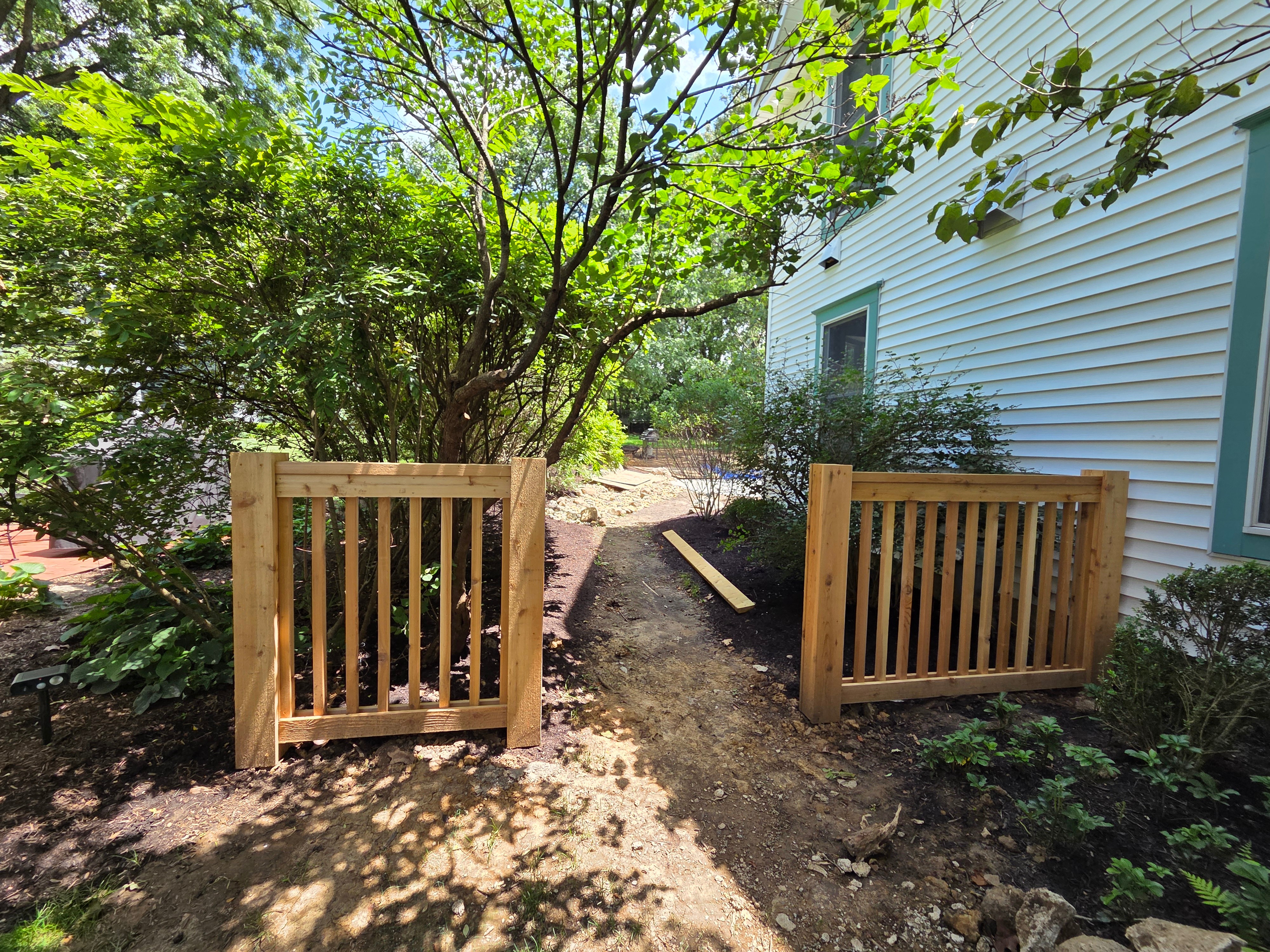
Cedar (~$38–$55/linear foot installed) brings warmth and natural character to a property. Contrary to what many assume, cedar doesn't require staining — it can be left to weather gracefully to a silver-grey patina with periodic surface cleaning. The real maintenance concern is moisture at the base. Cedar deteriorates quickly when it comes into contact with soil or mulch — and this happens more than you'd expect. Landscape maintenance crews routinely pile fresh mulch layers against fence boards without realizing the damage it causes over time. Keep the base clear of soil and mulch, ensure good drainage at grade, and cedar can be a low-fuss, long-lasting option. Lifespan: 15–25 years with reasonable care.
Vinyl (~$40–$60/linear foot installed; heavier or higher-end products: $48–$70) handles privacy beautifully with minimal upkeep — no painting, just periodic washing. It performs well in Ohio's wet seasons, though not all vinyl fencing is created equal. Cheap, hollow vinyl sections struggle in high winds and can look it. Heavier vinyl and composite fencing options deliver significantly better structural performance and a more refined, wood-like appearance — well worth the upgrade for a high-end property.
Aluminum (~$20–$55/linear foot installed) is the quiet workhorse — 30–50 year lifespan, rust-resistant by nature, and low maintenance. It's typically an open, ornamental style rather than a privacy fence, making it ideal for entries, pool perimeters, and estate boundaries. Aluminum doesn't absorb impact as well as wrought iron and can dent or bend if struck — but damaged sections are generally replaceable without redoing the whole fence, as long as you haven't chosen a rare style or color that's been discontinued.
Wrought iron (~$30–$80+/linear foot installed) sits in a category of its own for authentic estate character and visual weight. A well-maintained fence can last 50–100 years — but maintaining that standard means professional refinishing every three to five years at approximately $8–$10 per linear foot. For a 200-linear-foot fence, that amounts to $12,000–$28,000 in maintenance costs over twenty years, compared to roughly $4,000–$12,000 for aluminum over the same period. The look may be entirely worth it. Just go in knowing what you're agreeing to.
A hybrid approach often makes the most sense: wrought iron or heavier steel for focal gates and entry features where visual weight earns its place; aluminum for the long perimeter runs where endurance and low upkeep matter most.
Plants: Bigger Isn't Always Better — But Sometimes It Really Is
Plant material follows a different logic than hardscape, but the trade-off principle holds. Larger, more mature nursery stock delivers immediate impact — shade, screening, privacy, and architectural balance with the home. In the Columbus area, an installed shade tree runs approximately $545 at a 2-inch caliper and $1,725 at a 5-inch caliper — more than three times the price for a tree that performs from day one.
What's worth knowing: smaller plants often establish faster biologically. They retain a higher proportion of their root system relative to their canopy after transplanting, which reduces stress and accelerates recovery. Larger specimens carry more establishment risk — studies have documented significantly higher mortality rates among large-caliper transplants compared to smaller material.
The smarter play is a tiered strategy. Invest in larger specimens where scale matters immediately — primary entries, main terraces, pool areas, the sightlines from your most-used rooms. Use smaller material for massing, understory layers, and areas where a few growing seasons are perfectly acceptable. And regardless of size: plant quality matters as much as plant dimensions. A well-rooted, properly handled smaller tree will outperform a stressed or root-damaged larger specimen every time.
The Honest Bottom Line
This isn't an argument for always spending more. It's an argument for spending with your eyes open — knowing what you're genuinely choosing, not just at the moment of the quote, but five, ten, and fifteen years down the road.
The cheapest material at installation and the least expensive material over the life of a property are often two very different things.
What This Means for You
Material decisions don't happen in isolation. They're shaped by drainage, climate, use patterns, maintenance capacity, and how the whole site works together. When those decisions are made early — as part of an integrated strategy rather than under cost pressure in the final stretch — they tend to hold up and deliver lasting value.
Part of our design process at Schieber & Associates is coaching clients through exactly these decisions — helping each family weigh what matters most for their unique project, their property, and the way they actually live. We've been doing this for years, and we know how to help you distinguish between where to invest and where to hold back. If you're planning a build, a renovation, or trying to make sense of a property that hasn't been performing the way you hoped — reach out before the quote makes the decision for you.
Sources:
- Concrete Masonry and Hardscapes Association — Concrete Paver Performance and Maintenance
- American Cement Association — Freeze-Thaw Durability and Exterior Concrete Specification
- HomeGuide — Stone Patio, Paver, and Stamped Concrete Cost Guides (2025)
- Trex — Composite Decking Care and Winter Guidance
- U.S. Forest Service — Exterior Wood Finishing and Fence Maintenance
- 2025 Cost vs. Value Report, Columbus, OH — Journal of Light Construction
- National Association of REALTORS® — Remodeling Impact Report: Outdoor Features
- TileLetter — Exterior Tile and Porcelain Paver Installation Standards
- Hanover Architectural Products / Belgard — Porcelain Paver Technical Data
- Polycor — Natural Stone and Freeze-Thaw Performance
- Stand Strong Fencing, Akron OH — Local Fence Cost and Lifespan Data
- HomeAdvisor — Wrought Iron Fence Cost and Maintenance
- Aluminum Association — Corrosion Resistance and Maintenance Guidance
- Columbus Trees — Installed Tree Pricing by Caliper
- ISA Arboriculture Journal — Nursery Stock Transplant Establishment Research
- FHWA — Ohio Freeze-Thaw Cycle Data